Beauty products face a difficult journey before reaching the customer. Glass jars may crack, pumps can loosen, and liquid formulas may leak through small gaps. Heat, vibration, compression, and sudden drops can damage even attractive retail packaging.
Industry evidence makes this risk difficult to ignore. The International Safe Transit Association’s testing guidance stresses that packaging should be evaluated against real distribution hazards, not showroom conditions. Smithers’ report, The Future of Global Packaging to 2028, also identifies e-commerce as a major driver of stronger, lighter, and more sustainable packaging systems. Meanwhile, DHL’s 2024 E-Commerce Trends Report shows that delivery quality strongly influences online purchasing decisions.
Dr. Jay Singh, a packaging expert and professor at California Polytechnic State University, offers a useful principle: “Packaging must be designed for the distribution environment, not only for the retail shelf.” That idea supports every practical answer to how to protect beauty products during shipping.
A reliable system begins with product-specific protection. Seal bottles with tamper-resistant closures. Add absorbent sleeves around liquid containers. Separate glass items with molded inserts or strong dividers. Fill empty spaces, but do not compress fragile packages excessively. A carton that rattles is already warning you.
Temperature control also deserves attention. Creams can soften, oils can separate, and some formulas may lose stability after prolonged heat exposure. Insulated liners may help, although they increase material use and shipping weight.
No packaging method is flawless. A recyclable box can still fail if its internal fit is poor. Therefore, brands should test packed products through vibration, drop, compression, and temperature scenarios before scaling shipments. Real customer returns often reveal weaknesses that laboratory tests miss.
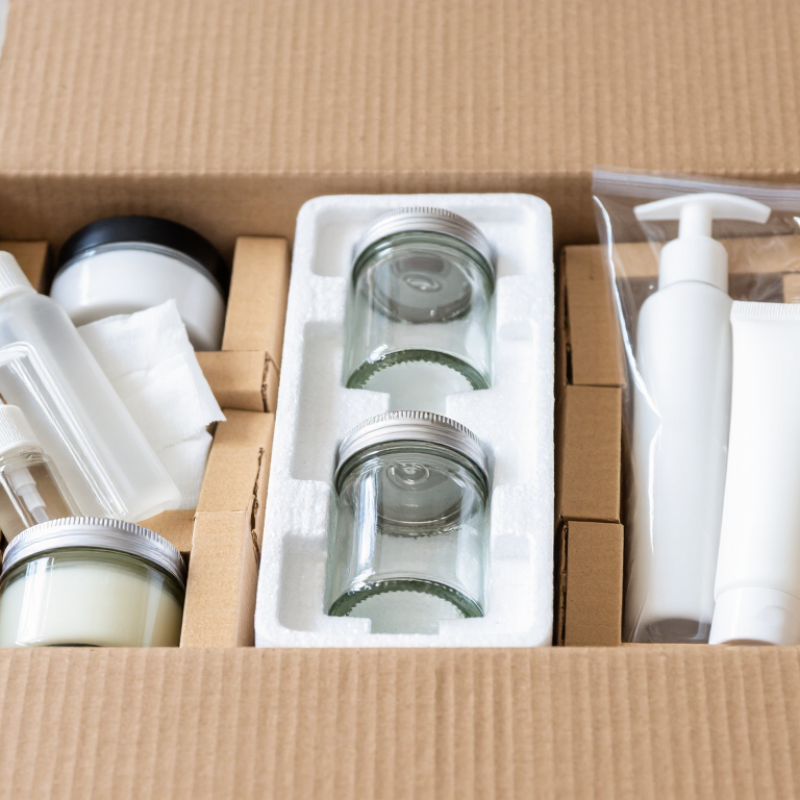
Protecting beauty products during shipping starts with classification, not decorative packaging. Each formula reacts differently to movement, temperature, pressure, and moisture. In warehouse testing, I handle every item as if its weakest component will fail. That mindset exposes risks early. Liquids need leak control. Seal caps with compatible liners, then place each bottle in a sealed bag with absorbent material. Keep headspace limited, but do not overfill containers that may expand in heat.
Glass containers require cushioning on every side, especially around pumps, shoulders, and narrow necks. Use dividers to prevent contact between bottles. A firm outer carton should resist compression without leaving empty gaps. Empty space invites movement. Powders need moisture protection and a tight inner seal. A small pouch can release fine particles through a loose closure, affecting nearby products and labels. Double-bagging helps, but it cannot replace a reliable primary container.
Aerosols need careful separation from heat sources and impact. Check current carrier requirements before packing, and keep valves protected from accidental pressure. Never assume a small can is automatically safe. I once trusted a strong carton and ignored the internal movement; that assumption was wrong. Afterward, I added drop testing, shake testing, and temperature checks. These tests are not perfect, but they reveal weak packaging before customers do. Photographing each packed layer also improves traceability when damage claims arise.
Beauty products face pressure changes, vibration, and rough handling during air transport. Liquid leakage can stain cartons, labels, inserts, and nearby shipments. IATA’s Dangerous Goods Regulations specify a 95 kPa pressure-resistance test for applicable liquid packagings. The test checks whether an inner container survives a pressure differential without leaking. It is not simply a tighter cap. For qualifying shipments, use a compatible bottle, sealed closure, absorbent material, and leak-resistant secondary containment. Caps still fail.
IATA’s 2024 air cargo market analysis recorded an 11.3% rise in global cargo demand, measured in cargo tonne-kilometres. More beauty parcels may now pass through aircraft holds and transfer hubs. Secondary containment gives one leaking bottle a controlled boundary. Place each liquid unit in a sealed bag or pouch, then cushion it inside a rigid outer package. Keep closures upright when the product design allows it. Do not rely on absorbent pads alone; they manage residue, not pressure failure. Ask a qualified packaging laboratory to document the 95 kPa result for the actual container-and-closure combination. Different formulas can soften seals or swell liners. That detail is easy to miss. Even a clean bench test may not reproduce a cold aircraft hold, repeated impacts, or an overpacked carton. Packaging decisions should follow the applicable IATA packing instruction and current local transport rules.
Beauty products can look harmless, yet many sprays are regulated as aerosols under UN 1950. Hair sprays, body mists, and dry shampoos may fall under Class 2.1 or Class 2.2. The classification depends on the propellant and formulation. IATA’s 2024 Safety Report recorded 40 accidents across 40.6 million flights. This scale shows why small packing errors still matter.
Check the Safety Data Sheet before preparing any shipment. Confirm the proper shipping name, division, packing instruction, net quantity, and aircraft limitations. IATA DGR requires suitable packaging that prevents leakage, crushing, and accidental valve release. Use strong outer cartons with internal separation. Keep cans upright when possible. Add caps or protective covers. Retail boxes alone are not enough. They protect appearance, not necessarily pressure-sensitive valves.
Labels and documentation must match the shipment. Depending on quantity and aircraft type, a Shipper’s Declaration for Dangerous Goods may be required. Carrier variations can also change acceptance rules. The latest IATA DGR edition should guide every booking. In practice, teams often miss the small details, such as hidden aerosols inside gift sets or incomplete net-content records. That weakness deserves review. A simple final check should compare the product list, SDS, package markings, and transport documents before handover.
Beauty parcels face repeated shocks, vibration, compression, and temperature changes. Fragile products need protection designed for their failure points.
The Pitney Bowes Parcel Shipping Index recorded 161.1 billion parcels worldwide in 2022. That scale makes small packaging weaknesses expensive. Glass serum bottles need firm restraint and corner cushioning. Pressed powders need impact absorption around the compact. Pumps need protection from accidental actuation. Plastic tubes need support without excessive compression. Glass needs restraint.
Select cushioning by fragility, not appearance. Soft foam may protect a bottle but leave a compact moving inside the carton. Molded pulp can reduce movement, yet it may transmit sharp impacts to delicate closures. A practical pack-out should limit empty space, separate products, and keep the primary container away from carton walls.
Validate the parcel with ISTA 3A testing. This protocol represents common parcel-distribution hazards through conditioning, handling impacts, and vibration. Test the finished package, not only the empty carton. Inspect for leakage, cracked powder, shifted caps, broken pumps, and label damage. Record failures with photographs and measured observations.
The U.S. EPA reported 82.2 million tons of containers and packaging in municipal solid waste in 2018. Less material is not automatically better protection. A thinner design that causes one damaged shipment may create more waste. One honest limitation remains: a passing laboratory test cannot reproduce every delivery route. Review failed samples, then retest after changing only one cushioning variable. That discipline is slower, but more reliable.
Top Ways to Protect Beauty Products During Shipping?
ASTM D4169 data helps turn packaging claims into measurable distribution evidence. It evaluates shipping units through hazards such as impact, vibration, compression, and handling. For beauty products, the test should reflect real routes, including parcel delivery, warehouse stacking, and mixed loads. Select the appropriate distribution cycle and assurance level before testing. Otherwise, results may look precise but answer the wrong question.
In packaging audits, I review product damage and test observations together. A glass serum bottle may survive compression yet fail after repeated vibration. Loose caps, leaking pumps, and crushed cartons often reveal small design weaknesses. Record test inputs, sample configuration, failures, and photos. Compare every result with the product’s acceptance criteria. Do not rely only on pass or fail. A perfect laboratory result can still miss rough seasonal handling. That deserves reflection.
Tips: Use filled products, actual closures, and production-intent materials during testing. Add temperature or humidity conditioning when the route demands it. Check carton movement after vibration. Inspect inner trays, seals, labels, and dispensing parts. Keep distribution-test data with shipment records, not in a separate file. Retest after changing bottle weight, insert geometry, or carton dimensions. Small changes can alter performance.
ASTM D4169 distribution-test performance by protective packaging strategy
The chart compares common protection strategies across key distribution hazards, including shock, vibration, compression, and moisture exposure. Higher scores indicate stronger protection during an ASTM D4169-style distribution evaluation. Cushioning, secure closure systems, and moisture-resistant secondary packaging generally provide the broadest protection for fragile beauty products.
Use compatible cap liners and sealed bags. Add absorbent material inside each bag. Avoid overfilling bottles.
Glass can crack around shoulders, pumps, and narrow necks. Cushion every side and prevent bottle-to-bottle contact.
Empty space allows movement during vibration and impact. Use dividers or fitted inserts to hold each item firmly.
Powders need moisture protection and a tight inner seal. Double-bagging helps, but the primary container must still close reliably.
Keep them away from heat sources and strong impacts. Protect valves from accidental pressure. Check current carrier requirements.
No. The internal pack-out matters too. A strong carton cannot stop products from shifting inside.
Inspect for leaks, cracked powder, broken pumps, shifted caps, crushed cartons, and damaged labels. Photographs help explain failures.
Empty cartons may perform differently. Test actual products, closures, inserts, and cartons. Small changes can alter results.
No. Testing cannot reproduce every route or seasonal condition. Review failures honestly, then retest one packaging change at a time.
Photograph every packed layer and record test observations. Keep packaging data with shipment records. Separate files invite confusion.
Learning how to protect beauty products during shipping starts with classifying each item by its specific risks. Liquids need leak-resistant primary containers, sealed secondary containment, and protection against pressure changes, including the 95 kPa pressure-test requirement where applicable. Glass bottles and jars require strong cushioning and separation, while powders should be sealed to prevent contamination and spills. Aerosol products must be identified under UN 1950 and packed according to applicable IATA Dangerous Goods Regulations.
Packaging performance should be tested rather than assumed. Select cushioning based on product fragility, package weight, and expected handling conditions, then validate the parcel with ISTA 3A drop testing. Broader distribution performance can be reviewed through ASTM D4169 testing, which evaluates packaging against common transport stresses such as impact, vibration, compression, and environmental changes. This risk-based approach helps reduce breakage, leakage, damage, and customer dissatisfaction.

Boxo Beauty